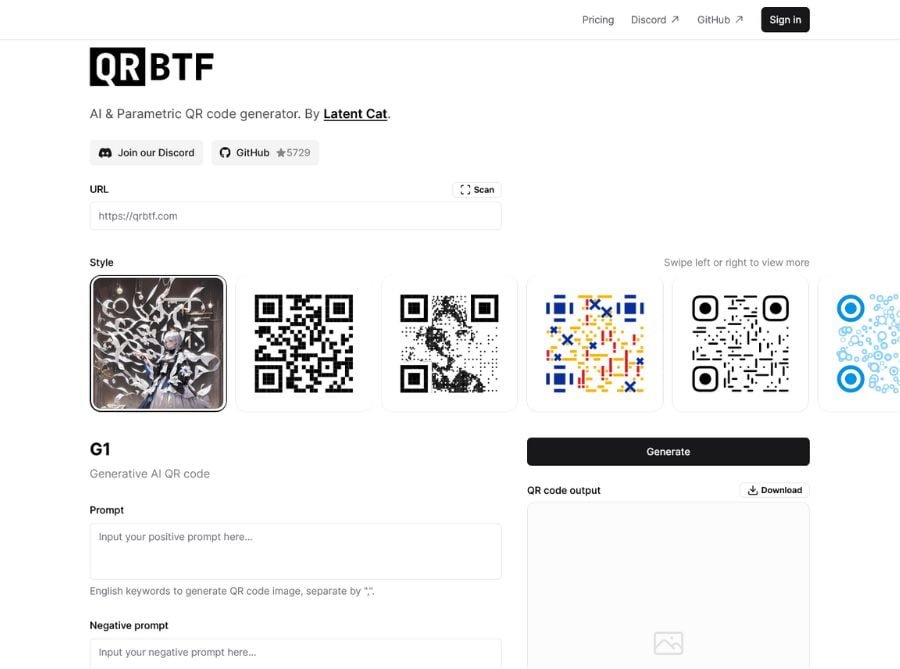
What is QRBTF?
Core Features of qrbtf.com
- AI QR code generation: Use prompts and a model like “realv2” to embed realistic landscapes, objects, and scenes directly into the QR pattern while keeping it readable.
- Parametric styles: Choose from multiple geometric/graphic styles (bubbles, pixels, frames, etc.), adjust colors, padding, and error correction, and export as JPG or SVG without any backend setup.
- Fine‑tuning controls: Customize seed, strength, restoration rate, size, padding ratio, anchor style, and more to balance aesthetics and scan reliability.
- React component library: The open‑source React-qrbtf library lets developers embed QRBTF styles in React apps and build their own variants via an API.
- Multilingual & modern stack: The latest QRBTF versions are rebuilt on Next.js/Nuxt.js with English/Chinese support and lazy‑loaded components for better performance.
How to Use QRBTF
- Open qrbtf.com and enter your content (URL, text, etc.).
- Choose either an AI style (with prompts) or a parametric template.
- Adjust style settings like size, padding, anchor design, seed, and restoration rate to tune the look and scanability.
- Generate the QR code, test it with a phone, then download it as an image or SVG for use in designs, packaging, or campaigns.
Use Cases
- Branded QR codes for posters, flyers, product packaging, and events that stand out visually but remain functional.
- Artistic QR codes for business cards, social media links, portfolios, and digital collectibles.
- Developer integrations in React apps using react-qrbtf to render custom‑styled QR codes directly in products.
FAQs About QRBTF (qrbtf.com)
QRBTF is used to generate artistic, fully scannable QR codes using AI and parametric styles, ideal for branding, marketing assets, packaging, and personal projects.
Unlike basic generators that output plain black‑and‑white codes, QRBTF lets you apply geometric styles and generative AI imagery (for example realistic landscapes or objects) while maintaining scan reliability.
Yes, QRBTF optimizes error correction, restoration rate, and anchor visibility so AI‑stylized QR codes remain readable, though you should always test with multiple devices before printing.
“realv2” is an AI model preset in QRBTF that specializes in generating realistic landscapes and objects inside the QR code pattern for more photographic designs.
Yes. QRBTF offers an open‑source React component library (react-qrbtf) that lets developers render styled QR codes directly in React projects.
You can adjust modules’ shape, colors, size, padding ratio, anchor style, and error correction level, plus download as JPG or SVG for use in design tools.
The core web tool is free for generating and downloading styled QR codes, while additional usage terms or limits are not prominently advertised and should be checked on the site.
Recent versions include QRBTF v3 (Next.js) and QRBTF.AI (Nuxt.js), providing faster performance and a modern, component‑based frontend.
QRBTF v1 is open source on GitHub, allowing users to study or adapt the basic parametric QR generator; newer AI features are primarily hosted on qrbtf.com.
Designers use QRBTF to create on‑brand QR codes for posters, business cards, landing pages, product labels, and event passes that visually match campaigns while remaining functional.