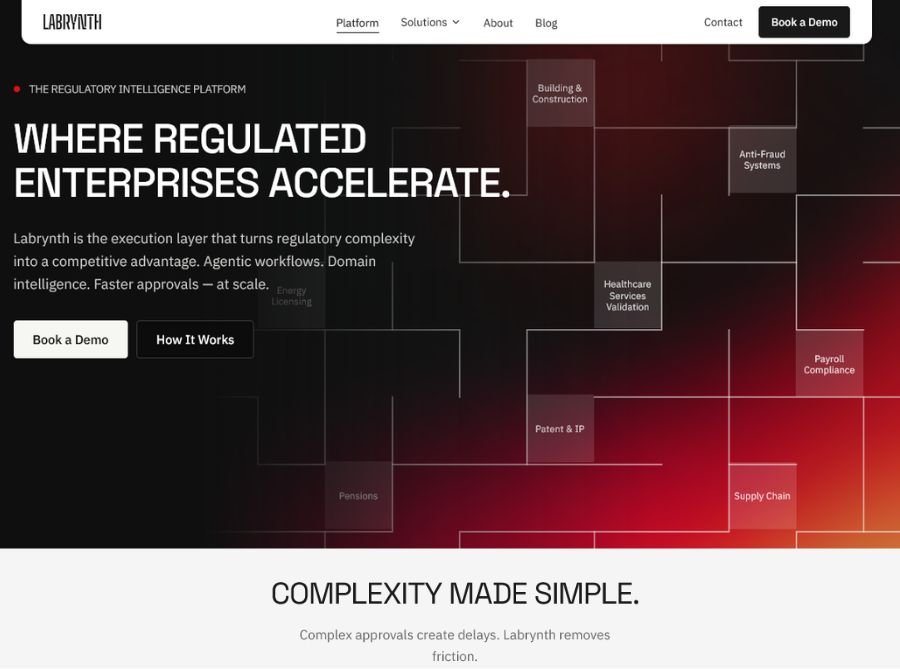
Labrynth.ai acts as an AI execution layer for complex regulatory workflows. It converts regulations, permits, standards, and internal policies into structured requirements, then compares those requirements against submitted documents and evidence to identify gaps before formal review.
The platform can support document preparation, compliance validation, evidence tracking, and audit-ready reporting. It is intended to reduce manual review work while keeping a traceable connection between each requirement, its supporting evidence, assigned owner, and submission status.
Labrynth is not simply a general-purpose chatbot. Its value comes from applying AI to domain-specific approval processes where accuracy, source citations, review history, and human oversight are important.
Key Features of Labrynth Ai
- Regulatory intelligence engine: Converts complex regulations, standards, and approval rules into structured, actionable requirements for project teams.
- AI document review: Reviews permits, licensing documents, applications, policies, and technical submissions against applicable requirements.
- Requirement-to-evidence mapping: Connects each obligation to the relevant document, evidence, owner, deadline, and review status.
- Compliance gap detection: Identifies missing requirements, incomplete sections, weak references, inconsistent terminology, and unsupported claims before submission.
- AI-assisted document preparation: Helps draft permits, licensing packets, compliance summaries, policies, and evidence packages using mapped requirements.
- Cited and audit-ready outputs: Generates review notes and reports with source references and traceability, making results easier for experts and regulators to verify.
- Human-in-the-loop workflows: Allows compliance experts and regulatory professionals to review, correct, approve, or refine AI-generated materials before they are submitted.
- Compliance monitoring: Tracks changing regulations, project status, evidence, and upcoming tasks through dashboards and alerts.
- Agent collaboration and automation: Multiple AI agents can coordinate tasks, monitor workflows, detect errors, and execute repeatable compliance processes through APIs and integrations.
- Industry-specific frameworks: Supports workflows involving standards and requirements such as NERC, FERC, NRC, DOE, NEPA, FDA, state licensing rules, and internal SOPs.
Use Cases of Labrynth Ai
- Construction permitting: Architects, engineers, contractors, developers, and permit consultants can use Labrynth to review plans, specifications, applications, and supporting documents before filing.
- Government and regulatory agencies: Regulators can use Labrynth to pre-screen applications, validate required information, and provide applicants with clearer guidance before formal review. This can help agencies process higher application volumes while improving transparency and consistency.
- Healthcare and life sciences: Healthcare organizations, medical-device companies, pharmaceutical teams, and digital-health providers can map obligations across FDA guidance, state licensing rules, payer requirements, accreditations, and internal policies.
- Energy and utilities: Utilities and power-generation companies can use Labrynth for NERC, NERC CIP, FERC, and audit-readiness workflows. The platform can connect regulatory obligations with operating procedures, evidence, technical documents, and review tasks.
- Nuclear and environmental compliance: Nuclear teams can apply the platform to NRC and DOE licensing, NEPA documentation, FSAR/PSAR reviews, safety analysis, and technical reference validation.
- Enterprise audit readiness: Large organizations can use Labrynth to organize evidence, assign compliance responsibilities, monitor deadlines, and create traceable documentation for audits and internal reviews.